The Company: One of the most underrated hip-hop crews in Germany - and sometimes damn far ahead of their time
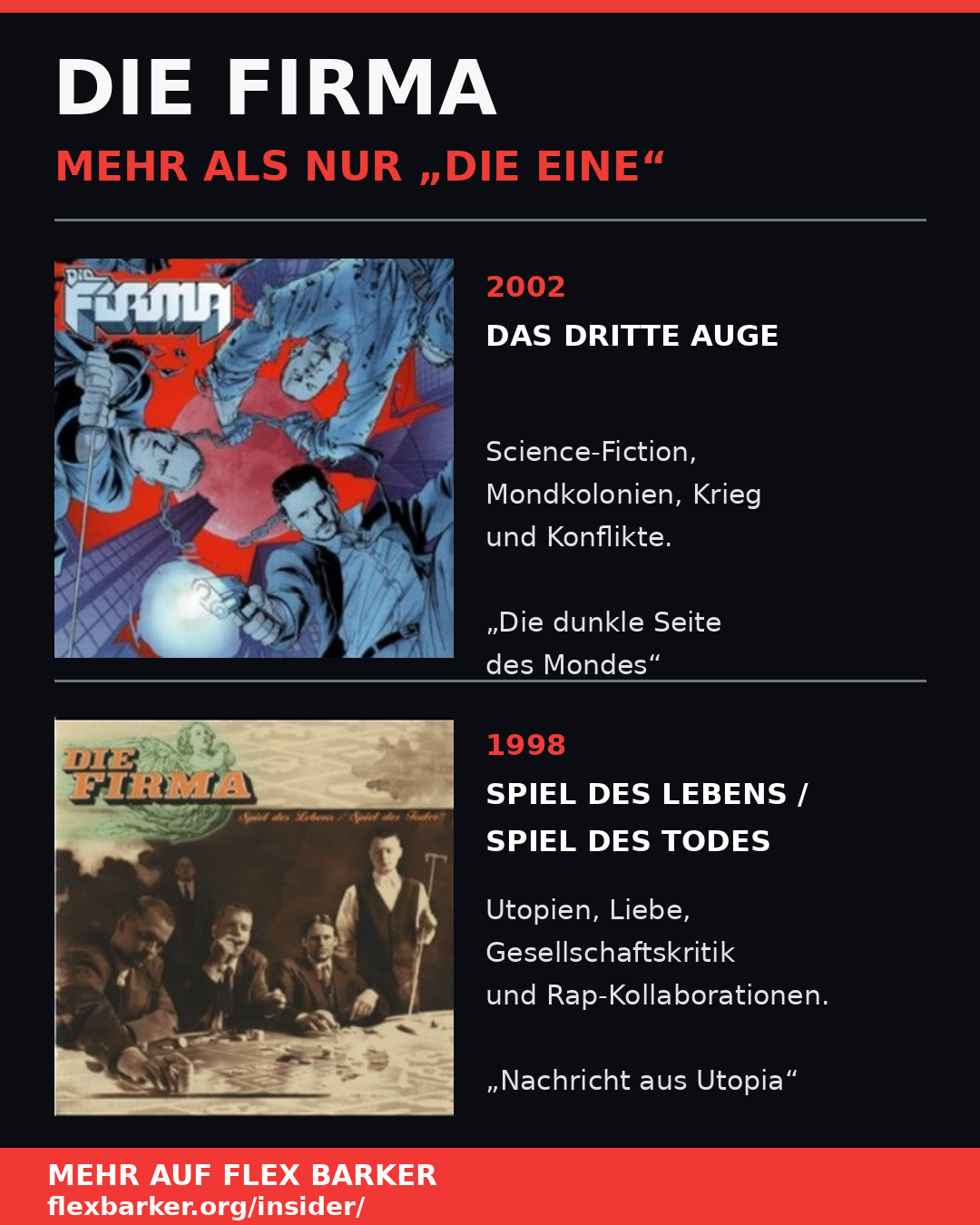
Environmental destruction, Climate change, artificial reality, secret space programs, Krieg, Religion, Love and social injustice. Plus Curse, Torch, Lakmann, Aphroe, Gentleman and songs with Mozart and Pachelbel. Anyone who reduces the company to just “The One”., missed a lot.
There are rap groups, who become immortal with a single song. And sometimes this very success is also their biggest problem.
At The Company it’s probably “The One”. A love song, that has burned itself deeply into the collective memory of German hip-hop. At least since the new edition of 2005 Practically everyone knows it, who was listening to the radio at the time.
But hand on heart: How many people know “Noah’s Ark Principle”?, „Ehrlich“, “The Dark Side of the Moon”, “Message from Utopia”, “Riders of the Apocalypse” or “No End in Sight”?
And how many know, that the company was already talking about environmental destruction at the end of the nineties, Resource consumption, Future technologies and the question rapped, whether humanity is destroying its own planet?
Or that she was concerned with a world long before today's AI debate, in which nothing seems real anymore?
The company wasn't just a rap group with good music. She told stories, asked questions and thought about things, that went far beyond the usual hip-hop cosmos.
"Noah's Ark Principle" (1999): When man destroys his own earth
Perhaps one of the group's most notable songs.
On The second chapter The company is concerned with a future, in environmental pollution, Technical progress and human irresponsibility threaten the basis of life on earth.
Smog, Industry, diseases, Dwindling resources and extreme environmental changes form the background of a bleak vision of the future.
This isn't just a general end-of-the-world fantasy. The song asks a pretty specific question: What happens, when humanity becomes more and more technologically efficient, but at the same time destroyed the foundations of their own lives?
“because no one knows how long the earth will last us”
The mentions of solar cells and hydropower are particularly interesting. Renewable energies are already part of a possible technological future here.
And then comes the actual social dimension: the idea, that privileged people could escape the destroyed earth, while others remain behind.
The biblical ark thus becomes a symbol of a modern escape from the consequences of human actions.
1999 That was a remarkable choice of topic for a German rap track. And 2026 The basic question seems anything but settled.
Because environmental destruction is not just a technical challenge. It is also a social question: Who caused the damage?, who bears the consequences and who can afford it, to avoid them?
„Ehrlich“ (2005): Alles Fake, all computer graphics?
Between the great visions of the future can be found War and Peace a track, whose central message seems almost incredibly relevant today.
“It’s all fake and just computer graphics”
A short sentence, the 2005 was created in a completely different media world.
Back then, there was neither today's flood of generative AI images nor the ubiquitous deepfakes. Nevertheless, “Ehrlich” deals with a fundamental human experience: At some point you no longer know, who or what to believe.
The song is about deception, false friends, superficiality, dishonesty and loss of trust.
Computer graphics become an image for a reality, in which more and more appears staged.
Today you can see it as a surprisingly fitting metaphor for our digital present.
Artificial faces, manipulated videos, made up news, staged CVs and people, who present a personality online, which has little in common with her actual life.
Of course, the company didn't predict today's AI technology. But they described a problem, which has become even larger thanks to these technologies.
What happens to a society, when honesty becomes the exception and no one knows anymore, what is really real?
That's a question, die 2005 was just as relevant as it is today.
“The Dark Side of the Moon” (2002): SDI, secret space travel and a science fiction film as a rap track
Now things are really getting crazy.
On The third eye The company released a song called “The Dark Side of the Moon”., which sounds more like a science fiction thriller than a regular rap number.
The story leads to a human colony on the far side of the moon. People live in artificial domes, explore strange worlds and get caught up in a web of secrets, Power structures and supposedly hidden history.
Historical events, Space travel, Cold War, Extraterrestrial civilizations and secret programs are processed into a coherent narrative.
“Forget CIA, FBI, the real enemy is called SDI.”
SDI stands for Strategic Defense Initiative, the American missile defense program, the US President Ronald Reagan 1983 introduced.
In the song, this becomes part of a much larger fictional conspiracy story.
Kennedy, Apollo, Mars mission, Terraforming and the idea of hidden space projects merge into a pretty wild scenario.
It should be clear: The song provides no evidence of real secret moon colonies or alien programs. He uses historical allusions and speculative ideas as material for his story.
And that's exactly what makes it interesting as a storytelling.
The company didn't need a film camera, no special effects and no million dollar budget, to create a science fiction world.
Music, two MCs, Words and the imagination of the listeners were enough.
“Message from Utopia” (1998): What could another world look like??
Already on the debut Game of life / game of death The company dealt with alternative visions of the future.
“Message from Utopia” is one of the songs, that show, that the group was not satisfied with a mere description of everyday life.
After all, Utopia is more than just a fantasy place. The term stands for the idea of a different society, of a different coexistence, maybe even a better world.
And so the track touches on one of the oldest questions of political philosophy: This is how the world actually has to work, how it works right now?
This is an exciting thought for hip-hop.
Because rap also emerged as an expression of people, who did not agree with their social circumstances.
The company combined this idea with its preference for unusual images and narrative concepts.
"Noah's Ark Principle", “Riders of the Apocalypse” and “Modern Prophets”: Religion as material for social questions
Another recurring motif in the lyrics of The Company is religion.
However, not exclusively in the sense of personal piety.
Biblical images, apocalyptic ideas and religious symbols are used, about human behavior, Power, Responsibility and possible future scenarios to think about.
“Noah’s Ark Principle” combines an ancient tradition with modern environmental problems.
“Riders of the Apocalypse” takes up the idea of the end of the world.
And the title “Modern Prophets” already points to the question, who actually claims, to know the truth about the future.
These are interesting motifs, especially when you think about it, how often religion, social power and fears for the future are connected.
The company didn't turn it into dry lectures, but hip-hop with dramatic images.
“No end in sight” (2002): Religion, Conflicts and a world after 11. September
With “No End in Sight” the company turned to another difficult topic.
The song was created at a time, in which the attacks from 11. September 2001 and the subsequent political and military developments shaped the public debate.
Religion, Violence, Images of enemies and social conflicts were suddenly omnipresent.
The company picked up on this atmosphere and addressed the question, why people keep fighting each other.
This is precisely where an important strength of sophisticated rap becomes apparent: He can ask complicated questions in an emotional way, accessible form, without having to pretend, as if there was a simple answer to everything.
“Bought Love”, “Beloved Enemy” and “Tears”: There was also space for interpersonal relationships
With all the doomsday scenarios, you could almost forget, that The Company also rapped about very personal topics.
Love, disappointment, Trust, Relationships and emotional conflicts were always part of her music.
“Bought Love” deals with the problematic sides of interpersonal closeness.
“Beloved Enemy” with Moses Pelham juxtaposes two seemingly opposite feelings in the title.
“Tears” takes us in a more emotional direction.
And of course “The One” is also part of it.
The difference is: These songs don’t stand in isolation, but alongside stories of environmental destruction, Science-Fiction, War and social problems.
That’s what makes the discography so varied.
The company could be romantic, without exclusively making love songs. Socially critical, without turning every song into a political speech. And experimental, without forgetting their hip-hop roots.
“Shareholders”: Curse, Aphroe, Stieber Twins and the concentrated old school power
In addition to the challenging topics, there was of course also classic rap sport.
And this is where it becomes legendary.
The company gathered eleven guests on “Shareholders” from their debut album:
Curse, Future Rock, Luxury Chris from the Stieber Twins, Te von Creme de la Creme, Aphroe by RAG, Rotzlöffel and Schivv from DCS, Gianni, Scope and Fast Forward by STF and Hans Solo by Äi-Tiem.
Eleven different voices, different crews and a lot of hip-hop history on a single track.
We have to be aware of this again today.
Curse, who later became one of the most famous German rappers of his generation. Aphroe, whose work with RAG is still one of the important chapters of Ruhrpott rap today. The Stieber-Twins connection, STF, DCS and the others involved.
“Shareholders” is more than your average feature track.
He documents a scene, in which collaborations across cities and crew boundaries were part of the culture.
Not everyone needed a huge commercial event, to make music together.
They met, rapped and pointed, what you could.
“Clash of the Titans”: Lakmann, Rick Ski and the next big round
A year later it opened The second chapter further.
“Clash of the Titans” once again brought together an impressive selection of MCs:
Pachel, Galla, Lakmann or Laki von Creutzfeld & Jakob, Work, Axl, Lenny, Rick Ski and Gianni.
Lakmann in particular should immediately catch the eye of today's German rap listeners.
Anyone who knows his later development, finds an early piece of his musical history here.
Rick Ski is also one of the names, which you shouldn't forget when looking back at German hip-hop culture.
These songs show a different side of The Company.
This wasn't about complicated visions of the future, but about skills, Flows, Presence and the joy of rapping together.
And that is also part of the history of this crew.
Torch, Gentleman, Africa, Moses Pelham und Olli Banjo
The list of collaborations doesn't end with the two posse cuts.
Torch, one of the defining figures of Advanced Chemistry, is represented, among other things, on “Those believed dead live longer” and also appears in connection with “Noah's Ark Principle”..
Gentleman enriched “The New Millennium” with his reggae influence.
Later came collaborations with Moses Pelham, Olli Banjo and Afrob added.
What stands out about it: The company did not limit itself to a single style or scene.
Classic boom bap, Reggae, narrative rap and technically demanding MC parts could coexist on the same releases.
Fader Gladiator: This music was partly pure cinema
An important reason for this, that many songs still work today, is Fader Gladiator.
His productions were often more than just rhythmic accompaniment.
Dramatic strings, dark melodies, atmospheric soundscapes, classical music motifs and powerful drums provided a sound, which gave the stories additional space.
Some instrumentals could also work in a thriller or science fiction film.
A particularly well-known example is “The One”, whose musical basis goes back to Johann Pachelbel's canon in D major.
“The New Millennium” again uses a motif from Mozart 40. Symphony taken up.
A distinction must be made between an audio sample that is actually used and a newly recorded or musically adopted template.
But regardless of the specific production technology, it is remarkable, how naturally classical music was incorporated into this hip-hop world.
Especially in connection with the big themes, songs with their own atmosphere emerged.
And that's a key part of it, what distinguished the company.
Why the company is still relevant today
Of course, The Company were not an unknown underground group.
The second chapter reached number eight in the German album charts. “Die Eine 2005” even made it to number two in the German single charts.
The group certainly had its successes commercially.
But the real question is: Is their entire musical work adequately perceived today??
When people talk about sophisticated storytelling in German rap, Songs like “The Dark Side of the Moon” should not be missed.
When it comes to early confrontations with environmental destruction and fears for the future, “Noah’s Ark Principle” should be included in the discussion.
When talking about reality, deception and digital staging, “Honestly” is an interesting rediscovery.
And when legendary German posse cuts are the topic, “Shareholders” and “Clash of the Titans” deserve a permanent place.
That doesn't mean, that The Company would have invented each of these ideas. Of course there were also other socially critical ones, experimental and politically interested rappers.
But The Company combined a surprising number of these approaches into a single discography.
And that is exactly where their special strength lies.
Conclusion: Maybe we should listen more closely again
The company rapped about a world, which could destroy itself. About people, that hide behind artificial facades. About secret moon colonies, military programs, Religion, Krieg, Future, Love and personal responsibility.
And in between there were curses, Torch, Lakmann, Aphroe and numerous other MCs on the microphone.
There were also productions, some of which sounded, as if someone had turned an entire movie into hip-hop music.
Of course, not every song has aged perfectly. Some ideas are pathetic, some deliberately exaggerated, other speculative or simply fantastic stories.
But that's not an argument against music.
On the contrary.
The company had confidence in its listeners: Fantasies, Attention and willingness, to also deal with uncomfortable topics.
Whoever reduces the group today exclusively to “The One”., overlooks a lot of creative work and an interesting piece of German hip-hop history.
So maybe just put on the old albums again.
Game of life / game of death.
The second chapter.
The third eye.
War and Peace.
And this time don't skip ahead after the well-known song.
Because sometimes the most underrated hip hop isn't that, that nobody knows. But the, which we have long forgotten, how much he actually had to say.